KIANEWS
Tommi Uitto has harsh words for open RAN
22. 08. 2022 Monday / By: Robert Denes / Generic / Exact time: BST / Print this page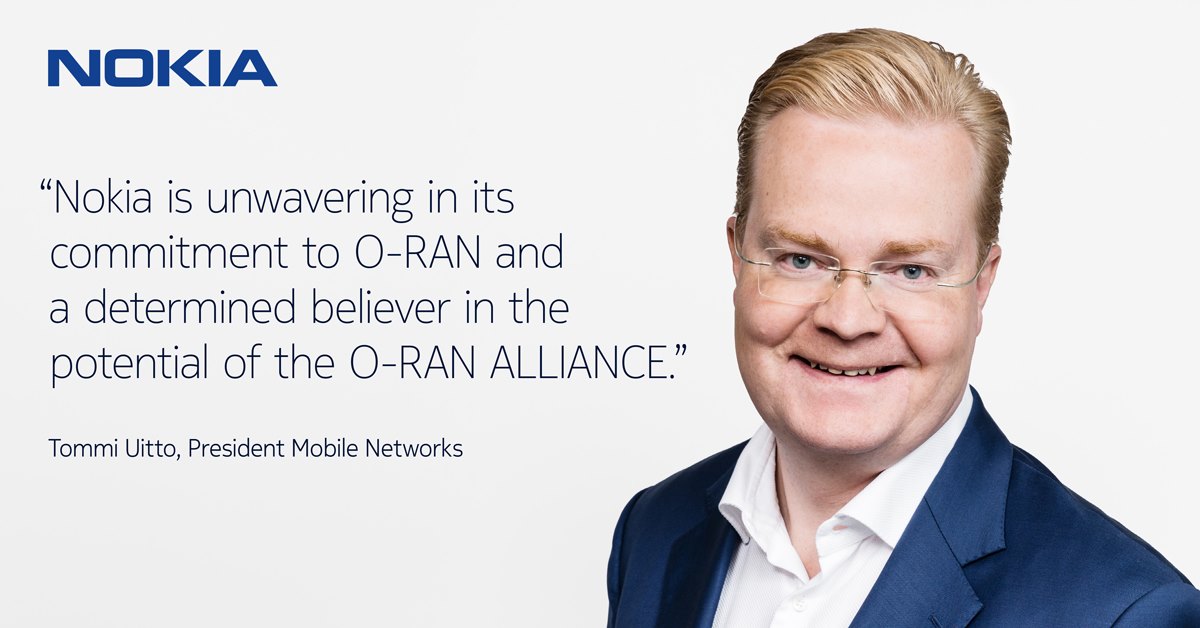
The industry has more or less decided that the young technology will be a success, almost regardless of its merits. For all their losses, Ericsson and Nokia generally want to be seen as accommodating, even dutiful mentors. Criticize or gossip and you risk upsetting the audience.
It all seems brave to voice Tommi Uitto's doubts. Nokia has previously been much more receptive to open RAN than Ericsson (friendly but cautious) or Huawei (downright aloof). But the head of the mobile business doesn't sound entirely impressed. Open RAN has little chance of boosting competition or reducing costs, and working with other suppliers in multi-vendor deployments remains too difficult, he told Light Reading at a meeting in London. Uitto must know that open RAN enthusiasts will use his criticism as evidence of Nokia's decline.
Often confused with virtualization, open RAN is essentially about unlocking the interface gateways between different parts of the radio access network so that service providers can accommodate mixed vendors. In the absence of this, telcos tended to rely on one large supplier to provide everything. If they could manage to run one manufacturer's radios with another's IT resources, they could work with specialists and stimulate competition in a market still dominated by Ericsson, Huawei and Nokia - or so they believe.
“The assumption is that more suppliers means more competition and prices will come down, which may not happen,” he said. “Is the pie big enough for ten different suppliers? There used to be ten different base station suppliers, but we chose less and less.”
According to Nokia's executive, the Finnish manufacturer itself consists of six and a half base station suppliers, after several rounds of consolidation. In addition to its own historical business, these include Alcatel, Lucent, Motorola, Nortel, Panasonic and Nortel's W-CDMA business.
"They all disappeared because they couldn't get there — there wasn't enough size and volume to survive," Uitto said.
“Sometimes people think that open RAN is going to be cheap. No, it is not. There is nothing that would make it cheap in the first place, because it is 3GPP-compatible base stations, but it also has the corresponding software open interfaces," he said. "In fact, some of the early versions of the open RAN challengers even had to use FPGAs to create the open interfaces, as we did in our first 5G products, and that certainly doesn't make the product cheap."
Chip manufacturers targeting the open RAN market have clearly adapted their products. According to Uitto, they abandoned the original belief that baseband processing could be done efficiently on general-purpose processors (a market where Intel dominates).
"The first thing the industry learned was that it makes for a very expensive product because they're not very good in the baseband," he said.
After experimenting with FPGAs, chip developers are now working on different types of hardware accelerators built on more customized silicon.
Via Link