 KIANEWS

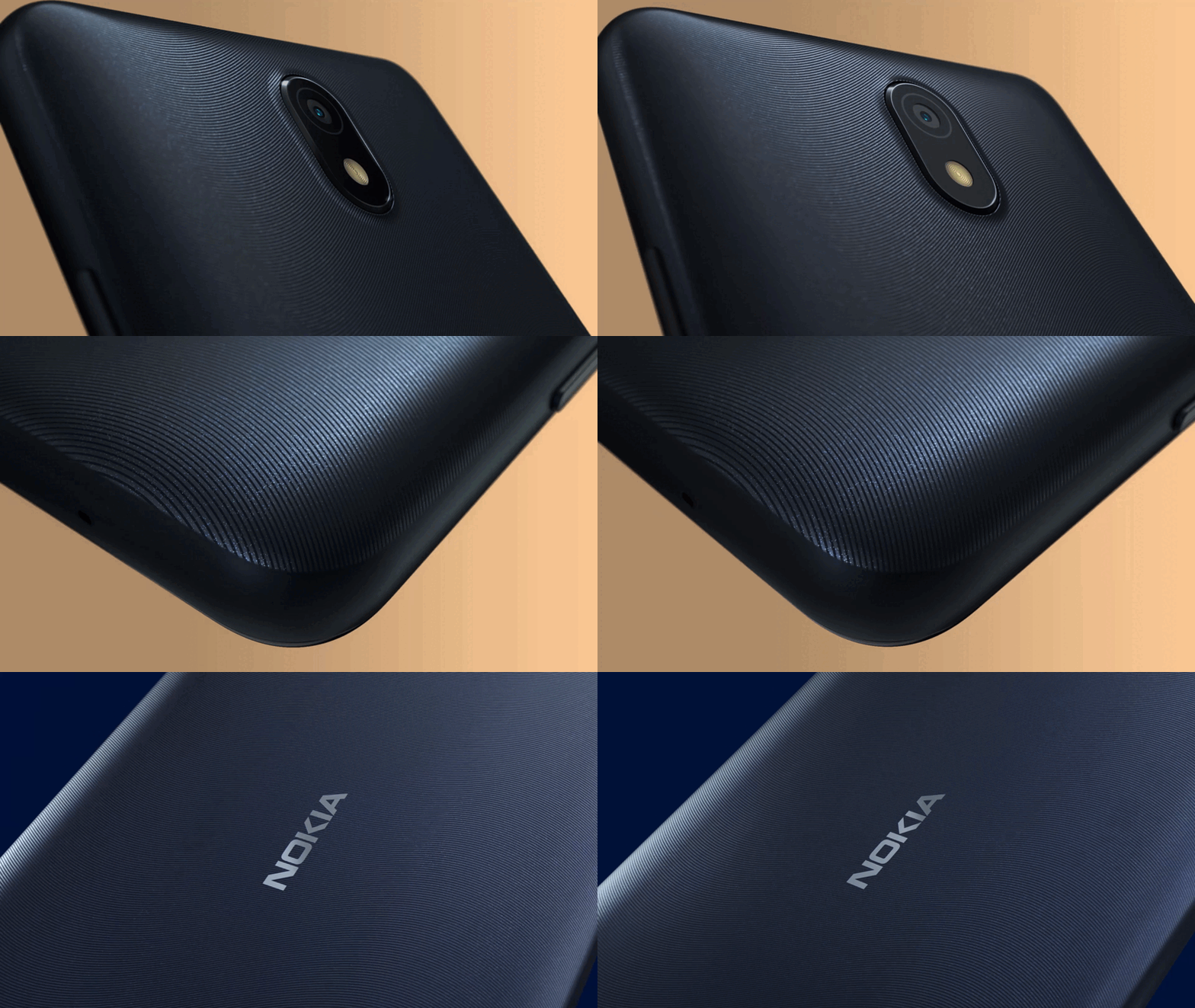

Finnish company HMD Global has launched a new HMD Fuse smartphone aimed specifically at children. According to the company, it is the world's first smartphone that prevents children from filming, broadcasting or viewing nude and sexually explicit content, even while streaming.
India expands midband as telcos make more 6GHz demands
14. 01. 2026 Wednesday / By: Robert Denes / Industrial / Exact time: BST / Print this page
I ndia’s spectrum allocation plan expands midband and satellite spectrum, but operators say more contiguous 6GHz spectrum is needed to meet demand.
The Indian government ended the year 2025 by releasing its National Frequency Allocation Plan 2025 (NFAP-2025). The document updates India’s spectrum roadmap to better align with global standards while expanding its focus on 5G, 5G Advanced, 6G and satellite services.
While Indian telecom companies have widely welcomed the government’s plan, they have reiterated their long-standing demand for the 500MHz band to be identified for International Mobile Telecommunications (IMT) frequencies.
"Due to India's unique market characteristics, high population density, rapid growth in mobile data consumption and relatively low fixed broadband penetration, mobile networks carry a large portion of the country's internet traffic, making the availability of adequate mid-band spectrum extremely critical," said Lt. Gen. Dr. SP Kochhar, Director General, Cellular Operators Association of India (COAI), in a press release.
COAI further states that all service providers require 400 MHz of continuous mid-band spectrum as fragmented spectrum would impact network performance and increase deployment costs. "Next-generation technologies will continue to rely on large, contiguous blocks of spectrum to support ultra-high throughput, low latency, immersive applications, AI-based services, smart manufacturing and smart mobility," the COAI note added.
NFAP-2025 covers the allocation of radio frequency spectrum from 8.3KHz to 3000 GHz. This identifies the IMT 6 425-7 125 MHz band, significantly expanding the mid-band spectrum for 5G, 5G Advanced and 6G services in the future. Mid-band spectrum is key to ensuring high data rates, low latency and better coverage. Globally, regulators in the US and Europe have harmonized and are using the 6GHz frequency band for both licensed and unlicensed services.
NFAP-2025 also includes a framework for satellite communications, which allocates the Ka, Q and V bands to satellite-based services, providing clarity for operators such as Starlink, Eutelsat and SES. These frequency bands support high-throughput satellite (HTS) services from both geostationary (GSO) and non-geostationary (LEO/MEO) constellations.
The plan provides additional spectrum for in-flight and maritime communications (IFMC) and supports new technologies such as vehicle-to-everything (V2X) intelligent transportation systems.
Via Link