 KIANEWS

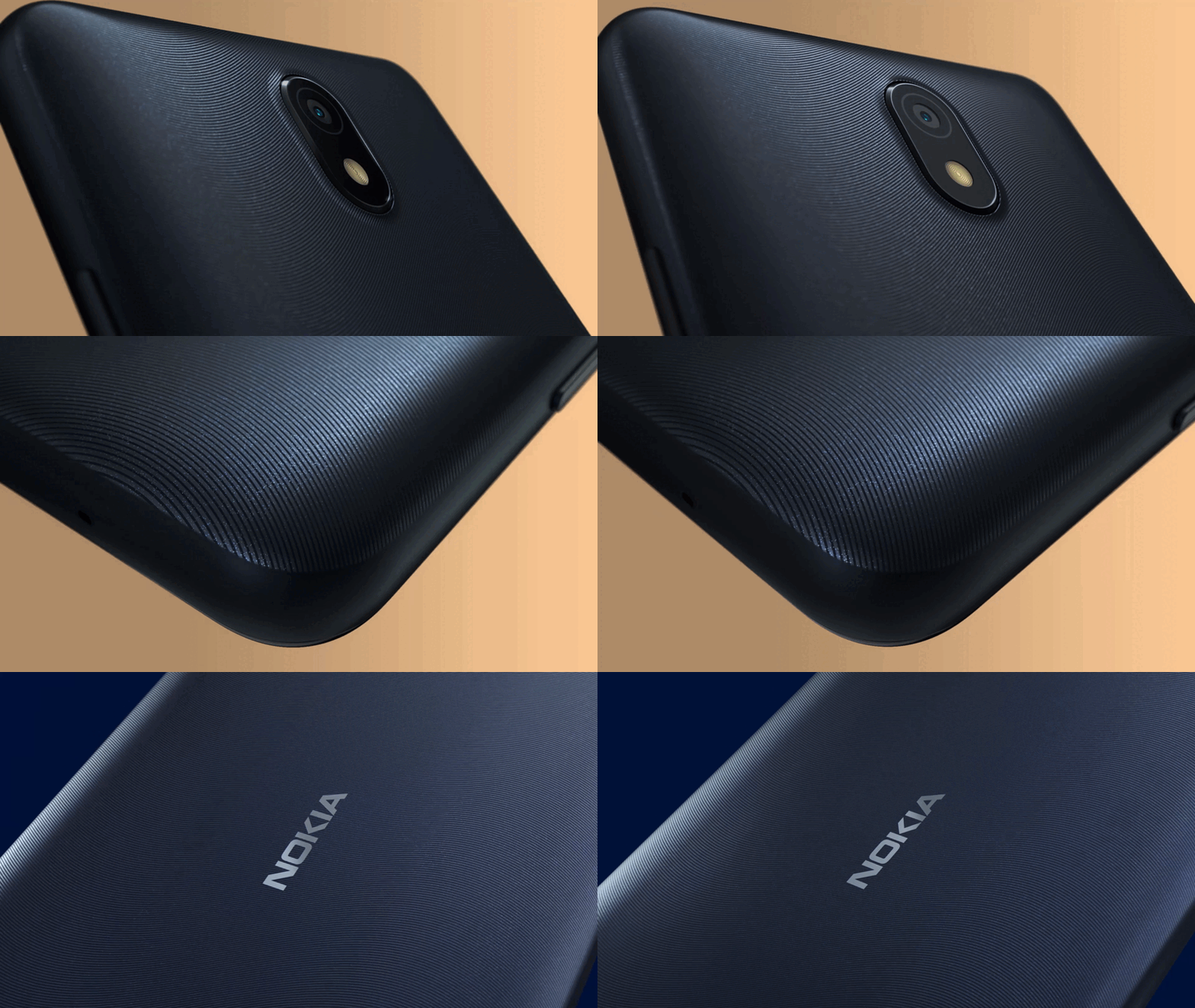

Finnish company HMD Global has launched a new HMD Fuse smartphone aimed specifically at children. According to the company, it is the world's first smartphone that prevents children from filming, broadcasting or viewing nude and sexually explicit content, even while streaming.
Acer and ASUS banned from selling in Germany after Nokia HEVC patent ruling
17. 02. 2026 Tuesday / By: Robert Denes / Industrial / Exact time: BST / Print this page
A German court has ordered Acer and ASUS to suspend sales of desktops and notebooks in Germany for infringing standard-essential patents related to Nokia’s HEVC codec. Retailers can continue to sell stock, but distributors are prohibited from placing new orders.
The ruling comes after a ruling by the Munich Regional Court in a patent dispute with Nokia over the H.265/HEVC video standard. The Seventh Civil Chamber concluded that both manufacturers infringed Nokia’s standard-essential video patents and refused to license them on fair, FRAND-compatible terms. The court subsequently issued injunctions prohibiting both manufacturers from offering, placing on the market, using, importing or possessing such devices in Germany. In practice, this affects a large number of current PC and notebook models, as HEVC is deeply embedded in the hardware and software layers of modern systems.
At a time when the PC market is in a stalemate due to a shortage of DRAM (and not only DRAM), German users looking for a laptop or desktop computer face additional difficulties: the Munich regional court, Landgericht München, has ordered Acer and ASUS to stop marketing their consumer solutions due to a patent dispute with Nokia. The main point of the dispute is said to be some patents related to the HEVC / H.265 video codec, a technology that has been integrated into almost every modern platform for years.
The effects are already visible in direct sales: Acer has officially temporarily stopped selling notebooks and desktops in Germany and only offers monitors and accessories in its own store. At ASUS, the German product pages are no longer regularly available for many systems, which means that direct sales have effectively stopped here too. Both manufacturers' German online presences mention maintenance work being carried out during these hours.
It is important to distinguish between manufacturers and retailers. The ruling was directed directly against Acer and ASUS, not against each individual retailer. Large platforms and retailers such as Amazon, MediaMarkt or Saturn can currently access and sell the stock, but they do not receive regular stock from the manufacturer channel. In the short term, this means that many devices are still available to end users, but in the medium term, the offer will be reduced if the legal situation does not change.
The lawsuit focuses on several standard patents from Nokia's HEVC/H.265 portfolio, including European intellectual property rights such as EP 2 375 749 and EP 2 661 892, which describe the basic video compression processes. Nokia filed parallel lawsuits against Acer, ASUS and TV manufacturer Hisense in 2025 at the Munich Regional Court and the Unified Patent Court (UPC). Although Hisense has now reached an agreement with Nokia and concluded a worldwide licensing agreement, the conflict with Acer and ASUS is now escalating and is taking the form of a de facto sales freeze in one of Europe's most important PC markets.
The Munich Regional Court has played a central role in the European SEP situation for years. In several decisions, the Federal Chamber has taken a relatively strict line in interpreting FRAND obligations, based on the case law of the European Court of Justice (Huawei v. ZTE) and the Federal Court. In the current case, the judges did not qualify the behavior of Acer and ASUS as sufficiently "licensable". This has paved the way for Nokia to stop and obtain a ruling on the issue, even though these are essential patents that are crucial for the implementation of H.265 in countless devices. For Nokia, this case is part of a broader strategy to consistently monetize its extensive patent portfolio. In recent years, the company has already filed lawsuits against Amazon, OnePlus and other providers, some of which have led to sales halts or technical modifications. As expected, the reactions of the affected manufacturers are defensive. Acer confirmed to its colleagues at PC-Welt that it will stop selling the affected products in this country and is considering further legal action. ASUS has largely refrained from making public statements, but consistent reports indicate that it will continue the legal dispute and is expected to appeal the ruling. Both emphasize in principle that they respect intellectual property, but otherwise refer to ongoing procedures and confidential licensing negotiations. For end users and the market, the case is already more concrete than the legal details suggest.
Technically, the conflictktus shows how vulnerable OEMs have become due to deeply embedded standards technologies. HEVC support can be found in iGPUs, dedicated GPUs, SoC media engines, and is used by operating systems, streaming services, video conferencing devices, and local players. In theory, manufacturers could try to disable certain HEVC features via firmware updates or configuration changes, or rely on alternatives such as AV1 or VP9. In practice, however, this is difficult to implement in the PC segment without significantly limiting users. The fact that Acer is removing entire PC and notebook sales from its German store instead of only applying it to selected models shows how comprehensively the affected technologies are embedded in their product range.
From an industry perspective, the Munich ruling sends a clear signal. OEMs, who have relied on chip developers and suppliers to cover all SEP risks, will need to take a closer look at what their licensing chains actually look like and whether their own business models offer attack surfaces. For do-it-yourselfers, the situation is more relaxed: components such as monitors, peripherals or many custom components will not be affected by the ruling.
The next steps will largely depend on whether Acer and ASUS obtain a stay of execution in a possible appeal or whether the orders will remain in force for the time being. However, the parties will likely continue to negotiate FRAND licenses. The example of Hisense shows that Nokia is willing to enter into large-scale licensing agreements if the terms are acceptable.
Via Link